The 2026 midterm election is just five days away, and it is vital that you know exactly who and what you are voting for! We have the Governor’s seat on our ballots in California, as well as a whole host of issues covered by 14 ballot propositions. While I have covered each one in depth over the past few months, I want to take today to recap my voting recommendations. I want you to be as informed, prepared, and empowered as possible come Tuesday – whether you are voting by mail between now and then or showing up to the polls on November 3rd. Because your vote MATTERS, even in our state, and your informed participation is required. So, get ready to take notes if you haven’t been tracking already, because today I am giving you my 2026 voter guide!

Governor’s Race: Why Voting Democrat Just Won’t Work
Let’s start with the Governor’s race. You have a choice in front of you in this election, and it is an important one. Because the choice is not really about the individual person you should elect for Governor, but more so about the ideas and values each person represents. In California, we can keep doing the same thing, expecting a different outcome, yet watching our state deteriorate under the weight of political continuity. Or we can look honestly at the issues our state is facing and the underlying policies that caused them, determined to make a change.
At this point, another Democrat, liberal, party-line Governor is unlikely to produce the change that California needs. Because, when we are honest and objective, it is the policy stances and legislative choices of the Democrat majority in our state who has created the environment we are in.
In 2024, homelessness in California reached record-highs. Of our nation’s homeless population, comprised of 771,500 people, twenty-four percent (187,000 people) lived in California.[1] Let that hit you – nearly a quarter of the homeless people across 50 states are concentrated JUST in our state. That is undeniably unsettling. Yet, our government leaders tell us they prioritize reducing homelessness! From 2018 to 2025, our government invested roughly $29 billion in state funding toward reducing homelessness[2] – the exact time frame when we hit record highs. That means whatever our government is doing, whatever programs they have put in place or housing they have built, just is not working. That is not biased, that is not just a conservative perspective, that is factual. Democrats have had control of the Governor’s Office and the Legislature through this entire period – so ask yourself, has Democratic leadership helped to reduce the homelessness crisis?
Then there is affordability. In the U.S. News & World Report 2026 Best States Rankings, California ranked 50th out of all 50 states for cost of living and housing affordability.[3] And this is not surprising, given the fact that California’s cost of living was 11% above the national average in 2024.[4] But California did not become unaffordable overnight. This is the result of decades of restrictive housing policies, high development fees, strict environmental reviews, and ever-increasing climate regulations and energy mandates. Californians spend more on groceries per week than other states across the nation, electricity rates have surged in recent years, our gas prices are sitting at an average of over $6 per gallon this week[5], and wages have not been able to keep up with the pace of inflation.[6]
Our Governor has blamed all of this on President Trump,[7] but these issues have been in place in California well before Trump’s second term. The cost-of-living statistic I cited was from 2024 – meaning California’s cost of living worsened throughout the four years of the Biden Administration…so I am unclear on how it is all attributable to Donald Trump. But that is a prime example of what our leadership does – they enact policies that worsen our state’s condition, then rather than own the results of those policies and change course to correct the consequences they have brought on, they instead seek to blame anyone else. So again, ask yourself, has Democratic leadership helped to make your life in California more affordable?
What about public safety? A 2026 study found that California is home to several of the most dangerous cities in the United States. Oakland has the nation’s second-highest crime rate, alongside other major cities like San Francisco, Stockton, and Riverside ranked for being the least-safe cities in the nation.[8] At the same time, major cities are struggling with severe police officer shortages. LAPD Chief Jim McDonnell reported that the police department needs at minimum 12,500 police officers to safeguard Los Angeles. They currently only have 8,550 – a shortage of nearly 4,000 police officers.[9]
But this too is not inevitable. This is a result of far-left criminal justice reform, which champions movements like “defund the police” while closing prisons across our state and supporting laws that give criminals more and more chances to commit crime before being arrested, charged, and imprisoned. Our state has aggressively undermined law enforcement and public safety actions but has not reckoned with the results that those policies have brought to our major cities. So again, ask yourself, has Democratic leadership helped to make your city in California safer?
We could go on and on about every major issue top of mind for voters, and I could show you how Democratic governance has not made the problems better. Literally every single one – because California is a dumpster fire and needs serious reform.
So, here’s the thing: Xavier Becerra is no different from Gavin Newsom, who was no different from Jerry Brown. The policies simply get more radical, more progressive, and double down on the exact same approaches we have been taking for years. There is nothing about Becerra’s policy platforms that would bring true change to our state because they are no different from what we have been doing, which means that things will only continue down the path we have been on. Now, that’s fine if you think California has no problems it needs to fix! But on its face, that is objectively not true. Experientially that is not true! Californians experience the consequences of the decline every single day, and it’s time to connect that experience to action.
You have a real responsibility here as a voter to vote for what is true. Because this vote is the difference between truth and lies. This is the difference between governance that HURTS real people, yourself and your family included, and governance that considers the problems being faced by the people and works to implement effective solutions. You must be honest, you must be informed, and you must be motivated to do what is morally good and right. I don’t care about your usual party preference or your voting record – this goes so far beyond party loyalty.
If you want California to survive, if you want to STOP the decline, if you want to preserve freedom and opportunity in our state, you MUST show up, and you MUST vote for Steve Hilton.
Propositions: My Voter Guide
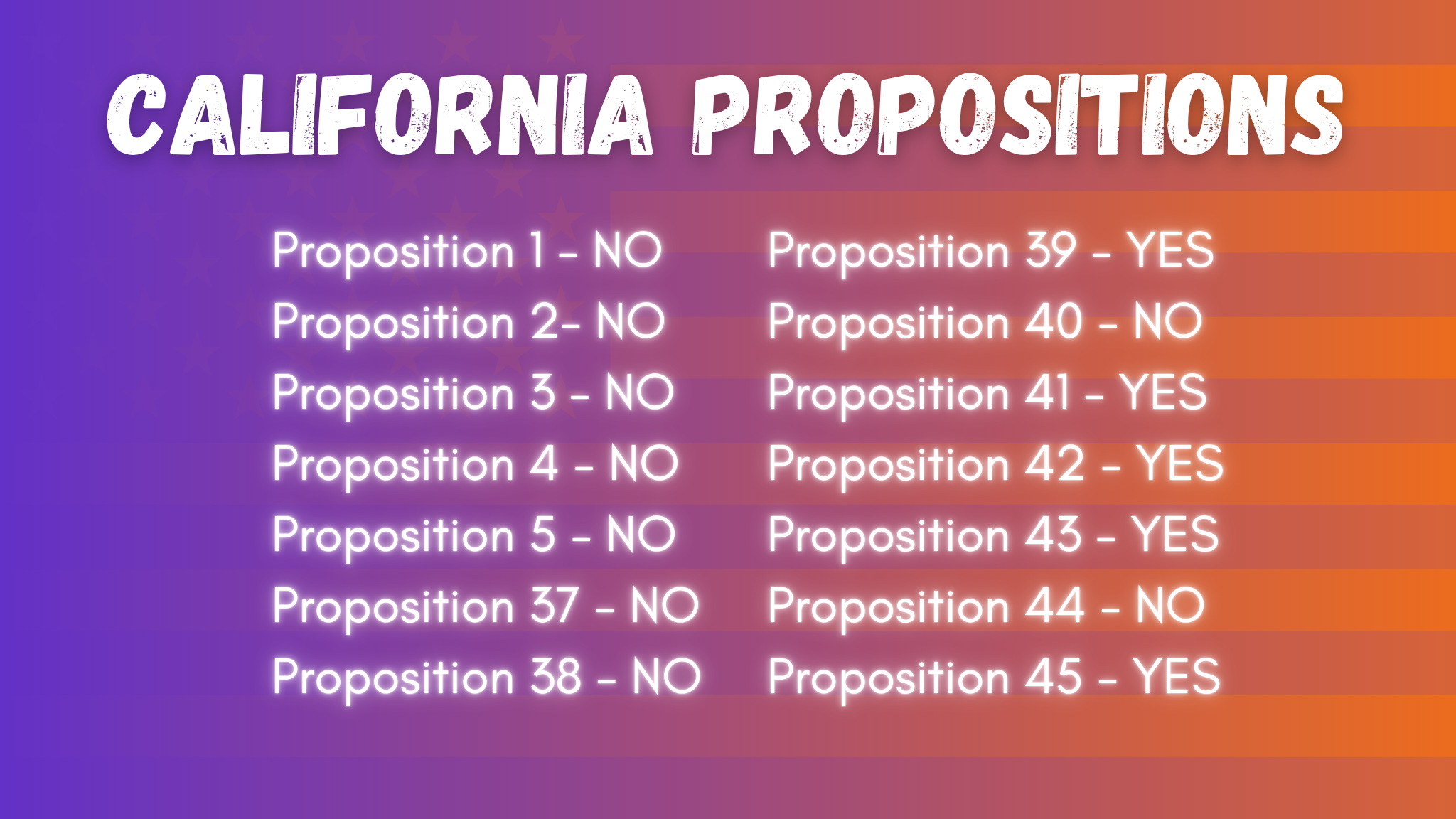
We also have 14 propositions on the California ballot – and they matter too! Over the past several months, we have covered each proposition in depth. But, as a refresher, I want to walk through the ballot together and boil down the key takeaways for each one so that you are fully prepared to vote.
Proposition 1
Proposition 1 would allow California to borrow $11.25 billion to fund housing programs. This would add an estimated $500–$600 million in annual costs to the General Fund for about 25 years. The policy debate underlying this proposition is whether borrowing $10 billion, and committing the General Fund to decades of repayments, is the best way for California to address its housing problems. What I argued is that Proposition 1 subsidizes the cost of housing but does not actually address the reasons why housing is so expensive. This means it will not work to reduce housing prices but will just have government cover part of the cost of housing. We have to look beyond the immediate benefit of government spending and ask what kind of environment we're creating over the next 10, 20, or 25 years. If the underlying housing market remains unaffordable, continually spending taxpayer dollars to subsidize housing doesn't actually solve the problem. Our goal should not be to create a California where people need a government subsidy in order to afford California housing. Our goal should be to create a California where housing is affordable enough that people don't need the subsidy in the first place.
So, on Proposition 1, vote NO.
Proposition 2
Proposition 2 would require California to make deposits into its rainy-day fund until it reaches 20% of General Fund revenues – current law only requires the fund to reach 10%, meaning it would double the savings requirements. It would also change the rules so that deposits to the rainy day fund do not count toward the annual spending limit.
But remember that revenue is not the problem in California, spending is. California does not struggle to bring in tax revenue; California struggles to spend that money wisely, to know which programs to prioritize, and to prevent itself from growing bigger and bigger, thus requiring more and more revenue. So, if we allow our government to put away more money year after year, presumably for the future, what are we really doing? We are allowing our government to take more of our money so that it can continue to fund its bad habits in the future, rather than having to face the realities of its overspending head on. California only needs to expand its reserves because it keeps expanding its spending commitments without addressing the underlying costs, but a larger reserve doesn't actually solve that problem.
So, on Proposition 2, vote NO.
Proposition 3
Proposition 3 would make the increased income tax rates, passed originally in 2012 and meant to be a temporary increase, permanent. Proposition 3 does not create a brand-new income tax or increase the rates taxpayers are paying today. What it does is eliminate the expiration date. So, to be clear, we are not being asked whether California should raise these taxes again, we're being asked whether these taxes should ever be allowed to go away.
But California already has one of the most progressive income-tax systems in the country, and yet the LAO projects budget deficits of roughly $35 billion annually beginning in 2027-28 under its fiscal outlook. So, just practically, “taxing the rich” has not proven to benefit California in the supposedly easy way that politicians and others who tout this as the solution to every budget crisis make it sound like it is. And of course, it will never come to an end, because as spending increases, they will never be satisfied with the amount of revenue they are generating.
If California wants more of our money, California should first demonstrate that it knows how to responsibly spend the money it already has. Right now, I don't at all see how it has made that case.
So, on Proposition 3, vote NO.
Proposition 4
Proposition 4 would make it so that taxpayer funds can be used for campaign financing. But, under current law, California generally prohibits state and local governments from using taxpayer money to fund candidates' election campaigns. Proposition 4 would repeal that prohibition, allowing state and local governments to establish public campaign financing programs.
But we must remember that the purpose of taxes should be to fund the functions of government that we collectively need – public safety, infrastructure, essential services, and the other responsibilities of government. Under Proposition 4, you could be a conservative voter whose city council is dominated by progressive politicians, and your tax dollars will go toward funding the campaigns of candidates whose policies you strongly oppose. Is this an essential function of government that you want to be giving your money toward?
California already has a long list of competing demands on taxpayer dollars! Before we create another way for government to spend money, we should be asking whether that spending is necessary, whether the safeguards are sufficient, and whether the proposal actually solves the problem it claims to solve. Proposition 4 absolutely does NOT clear that bar.
So, on Proposition 4, vote NO.
Proposition 5
Proposition 5 would remove the ability for voters to elect who they want to replace a recalled official at the time of the recall election. Right now, when you vote in a recall election for an office like Governor, you vote on two questions: 1) should this official be recalled, and 2) who should replace them. Proposition 5 removes the second question.
This seems like a minor change, but what does this do? In reality, Proposition 5 just makes it harder for voters to remove a politician and immediately replace them with a candidate of their choosing. If we're going to give citizens the power to recall elected officials, we should absolutely preserve their power to decide who will replace them. Recall elections are meant to be a tool of accountability, we shouldn’t dilute that ability. If we want government to be accountable to the people, then the people should have the final say over who represents them.
So, on Proposition 5, vote NO.
Proposition 37
Proposition 37 would create a new state program to help middle-income Californians buy their first home by helping them cover a large portion of their down payment. The state could issue up to $25 billion in revenue bonds to fund the program. Homebuyers would be required to put down at least 3% of the home's purchase price, and California could provide a loan for up to another 17%.
This is a tempting proposition, and a lot of voters will vote yes out of self-interest. But I want to challenge us to do what is best for the long-term economic environment in our state, not just what will give you as an individual the most cash right now.
The thing to understand is that assistance is not affordability. If the government gives you money toward your rent, that may make your rent more manageable, but it doesn't mean your rent is affordable. If the government gives you money toward your down payment, that may make it possible for you to buy a house, but it doesn't mean the house is affordable.
You have more assistance, but the affordability has not changed. If we have a housing market where homes are fundamentally too expensive, and our response is to give qualified buyers more purchasing power, we are once again treating the symptom rather than the underlying problem.
So, on Proposition 37, vote NO.
Proposition 38
Proposition 38 would allow California to issue an $8.4 billion general obligation bond to fund immunology and immunotherapy research. The California Department of Public Health would select a research institute to receive $4.2 billion of the bond, and the remaining funds would be awarded competitively.
Remember with this proposition that the question we ought to be asking is not whether medical research is good. The question instead is whether California taxpayers should be borrowing $8.4 billion to fund this particular research program, and whether this proposition is structured in the best interests of California taxpayers. I walked us through concerns about necessity for another debt-funded program when there are several other avenues for funding medical research, about the cost posed to our state and to taxpayer by incurring new debt, the role of the government in choosing to prioritize one type of medical research, and about the underlying motives for the proposition. It appears that the proposition is written to benefit one specific institution, the California Institute for Immunology and Immunotherapy, and medical scholars are raising the alarm about an insider arrangement.
In summary, if California wants to invest in medical research, there are better ways to do it – fund research through existing competitive programs, leverage private and federal dollars, and allow researchers to compete based on the quality of their science.
So, on Proposition 38, vote NO.
Proposition 39
Proposition 39 would require California voters to provide government-issued identification when they vote. This is THE Voter ID proposition! It would also require California to provide an ID adequate for voting requirements to any California voter who asks, for FREE. Meaning this proposition requires Voter ID, and also provides Voter ID for all those voters.
This is one of the most basic ways we can protect the integrity of our elections – something California is not famous for doing. In order to restore basic public trust in our elections, we need to take action to safeguard against illegal election procedures – such as non-citizens voting.
So, on Proposition 39, vote YES.
Proposition 40
I could spend the entire episode recapping all the details about Proposition 40 – and I have talked about it in three separate episodes! But to recap, this is the infamous wealth tax. This would impose a one-time tax of 5% on the total assets minus liabilities of anyone in California who had wealth of $1 billion or more at the start of this year. The initiative is being pitched to raise around $100 billion to help shore up state funding for health care.
This would have serious implications for our state. The biggest one is wealth migration, as billionaires have already fled California or pledged to leave if this proposition passes. This is incredibly important because California’s budget is already volatile due to heavy dependence on capital gains taxes from wealthy residents. If even a handful of billionaires relocate out of state, the long-term loss over the next several years could severely outweigh the one-time gain. While California might get a temporary boost for one year, in the years to come its revenues will decrease significantly. This will lead to investment slowdown, as there are less individuals here to invest in new business ventures.
This also creates a constitutional structure for our government to impose this type of tax again in the future, on the assets and net worth of individuals – and so this will not be the only tax of its kind. None of that is to even mention the fact that the projections for the revenue brought in by the wealth tax are wildly off, meaning independent researchers are saying it will actually have a net loss rather than gain due to the economic implications.
There is so much more that could be said, and if you want to know more you should go back and rewatch my couple of episodes on this proposition. But the bottom line is, on Proposition 40, vote NO.
Proposition 41
Proposition 41 makes three key changes. First, it requires the State Auditor to review the programs a proposed special tax would fund before the measure qualifies for the ballot. Second, it requires ongoing audits every four years of programs that continue to receive funding from enacted special taxes. And third, it generally requires revenue from new special taxes to count toward California's constitutional spending limit, rather than allowing that spending to be excluded.
At its core, this proposition says that if the government is going to ask you to pay more in taxes, it also has a responsibility to show you where that money is going. Before asking voters to approve a new special tax, there should be an independent review of the programs it would fund. After that tax is enacted, there should be ongoing oversight to ensure those dollars are being used as promised. And there should be meaningful limits on how much additional spending government can take on. If government wants more of your money, taxpayers deserve transparency, accountability, and confidence that every dollar is being spent wisely.
I absolutely agree with this, as we need greater accountability in the California government specifically with regard to how our tax dollars are being spent. So, on Proposition 41, vote YES.
Proposition 42
Proposition 42 is in direct opposition to the wealth tax. This proposition would prohibit new state personal property taxes and certain retroactive state taxes. This is exactly what Proposition 40 (the wealth tax) would enact, so it works to counter the implementation of a wealth tax.
This is important because a wealth tax would move from taxing the income earned in the tax year, to taxing the total value of your net worth, meaning what you own (your assets) less what you owe (your liabilities). It would prevent California from taxing someone simply because they own a certain monetary value of stocks, investments, or business assets. It would also prevent the type of wealth tax proposed in Proposition 40 from being implemented – not just this year, but as a future model for taxation in the state. I believe this is important for us as voters to make our voices heard on and show our legislature and our leadership that we will not tolerate more taxes, and easier taxation structures, in our state.
So, on Proposition 42, vote YES.
Proposition 43
Proposition 43 seeks to make it harder to increase taxes. Under current law, special taxes that are proposed by voters are approved by a majority vote. Proposition 43 would make it so that any special taxes proposed by voters would require a two-thirds vote to pass.
Remember that we talked about the fact that we have become numb to our government taxing us more and more. We should not make it easy for our government to take more and more from us – especially given how much revenue they already bring in and misuse. When there is an additional financial obligation and burden imposed on taxpayers, it should require a higher threshold to pass that proposition than just barely getting over 50%.
So, on Proposition 43, vote YES.
Proposition 44
Proposition 44 is another healthcare proposition. This would require private nonprofit safety-net clinics to spend at least 90 percent of their total revenue each year on program services.
This, again, sounds reasonable on the surface. If a nonprofit clinic exists to provide healthcare to underserved communities, shouldn't most of the money it receives actually go toward providing that care? But we looked together beyond the appealing goal and asked whether the policy actually accomplishes what it promises.
While nonprofits absolutely need to be accountable for their use of funds, Proposition 44 falls short. It creates a very clear number that regulators can enforce, but clear isn't necessarily the same thing as effective. Instead, the questions we should be requiring nonprofit organizations to answer are: are you using your money responsibly? Are you actually serving patients? Are you transparent about your finances? And are you misusing public or charitable funds?
While I agree with the goal that nonprofit organizations that receive taxpayer dollars should be held accountable for how they spend those dollars, I don't think a blanket 90 percent spending requirement is the best way to accomplish that, and I certainly don’t think accountability can be accurately measured by how little an organization spends on administrative costs.
So, on Proposition 44, vote NO.
Proposition 45
Lastly, Proposition 45 centers around the housing crisis. It is an attempt to make the environmental review process for housing development faster, and to make it harder for CEQA litigation to completely derail development projects. It puts tighter deadlines on the government to turn around CEQA reviews, it changes rules for the CEQA reviews themselves, and it limits what courts can consider in CEQA lawsuits so that courts cannot halt development projects altogether.
Remember that CEQA – the California Environmental Quality Act – is incredibly burdensome to development in our state and is attributable to rising housing and development costs. This would start to roll back some of the required provisions under CEQA – something conservatives have been calling for years.
So, on Proposition 45, vote YES.
Get Out and VOTE!
So, there you have it! All my recommendations for our statewide propositions, as well as my argument for Steve Hilton for Governor. Now, there are a LOT of other items on your ballot, and it will be specific to your county as well. SO, I have done my best to link as many resources as possible below for you regarding judges, the remaining statewide offices, and where to find out more information about local measures. If you need help finding answers to any of your questions, please reach out through my website and I will do my best to get back to you!
But remember this: we vote to be faithful to what we know is right and best. We vote to make our voices heard. We vote to change ourselves and our communities. That means no matter how “good” you think a candidate’s odds are of winning, or regardless of California’s political history, it is your duty, responsibility, right, and incredible PRIVILEGE to cast your ballot this election. You must vote. It can only HELP your cause!
So, this election day, get out there and vote! For the future of our state, and for the good of those around you.
Voting Resources:
Trusted Voter Guides Statewide and by County: https://www.reformcalifornia.org/voter-guides-list
District & State Recommendations: https://www.sway.co/elizabethbarcohana/recs
*both of the above resources also contain recommendations for the Judge positions on your ballot!
References:
[1] Cremin, Sean. “Homelessness Hits Record High in California, Jumps Dramatically in Rest of US.” Public Policy Institute of California, March 25, 2025. https://www.ppic.org/blog/homelessness-hits-record-high-in-california-jumps-dramatically-in-rest-of-us/.
[2] California State Association of Counties. “CSAC Statement and Funding Analysis on California’s Homelessness Crisis - California State Association of Counties,” May 15, 2025. https://www.counties.org/news-and-media-article/csac-statement-and-funding-analysis-on-californias-homelessness-crisis/.
[3] U.S. News & World Report. “Overview of California,” 2026. https://www.usnews.com/news/best-states/california.
[4] Asperin, Alexa Mae. “California Ranks Dead Last in Affordability, No. 35 Overall in 2026 Best States List.” FOX 11 Los Angeles, July 28, 2026. https://www.foxla.com/news/california-affordability-us-news-best-states-2026.
[5] “AAA Fuel Prices,” October 23, 2026. https://gasprices.aaa.com/?state=CA.
[6] Barton, Stephanie. “Five Fast Facts on the Cost of Living in California.” Public Policy Institute of California, May 21, 2025. https://www.ppic.org/blog/five-fast-facts-on-the-cost-of-living-in-california/.
[7] Dan Walters, “Newsom Blames California’s Worsening State Budget Outlook on Trump’s Tariffs,” CalMatters, May 14, 2025, https://calmatters.org/commentary/2025/05/california-budget-may-revise-trump/.
[8] Banchariya, Sheetal. “California Is Home to Some of the Most Dangerous Cities in US — Bay Area Near Bottom of Safety Ranking.” California Post, July 28, 2026. https://nypost.com/2026/07/28/us-news/california-metros-ranked-among-the-most-dangerous-cities-in-us/.
[9] Chapman, Ben, David Thompson, and Jamie Paige. “Exclusive | LAPD’s Top Cop Reveals Staggering Extent of Police Shortage.” California Post, July 26, 2026. https://nypost.com/2026/07/25/us-news/lapd-chief-details-extent-of-citys-growing-police-shortage/.